Conference IDs and Badge Pickup
Competitors will receive their HOSA Canada ID by March 5, 2026 through email. To participate in your competitive event and workshops, you must have either your physical badge or email with your ID.
Physical badges must be collected by March 9 at 2 PM to continue attending events and workshops.
- If your event is before 2 PM on March 9, proceed to your event with your emailed HOSA Canada ID.
- If your event is after 2 PM on March 9, you must pick up your badge before your event.
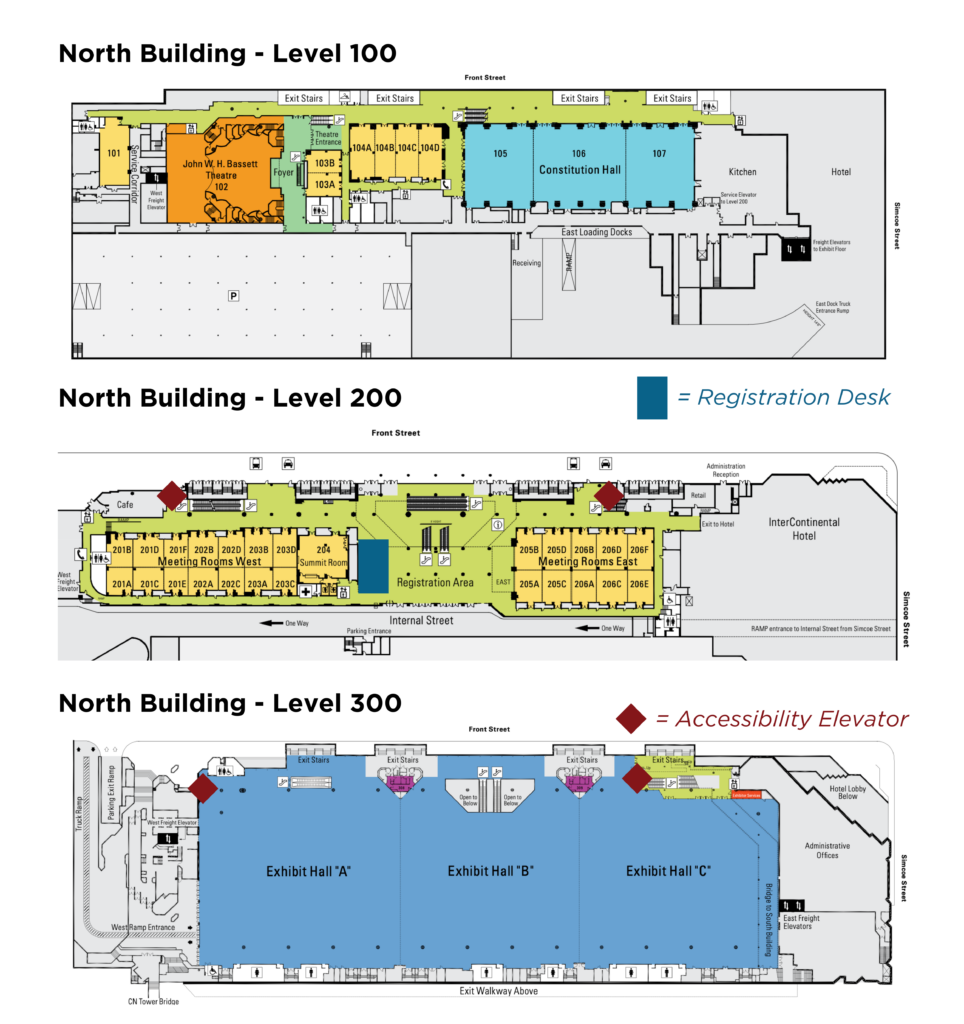
The registration desk is located on the west side of the Level 200 lobby.
Only chapter presidents and advisors will be permitted to collect physical badges for their students. Photo ID (e.g. Driver’s license or School ID) is required to register. Students who are not the chapter president should not wait in the registration line as we will not be able to provide them with their badge.
For community chapters, the Chapter Advisor must pick up the badges on behalf of the chapter. The advisor who picks up the badges must have already signed the HOSA Canada Community Chapter Liability Form. If a community chapter does not have the correct number of advisors/forms signed, they will not be provided with SLC badges.
It is recommended that chapters plan a designated meeting place to distribute badges so their chapter members know where to go when they arrive at the MTCC.
Dress Code
Competitors are expected to adhere to the official HOSA Dress Code at all times throughout the conference. You are not required to purchase the HOSA uniform.
Attending Your Event
Please arrive outside the room 30 minutes prior to the start of your event. Make sure you have your HOSA Canada ID (email or badge) with you. For written tests, check the tab “Written Tests” to see when you need to arrive to Hall B before your test to receive important seating instructions.
Competitors are expected to bring all of the materials listed in the “Competitors Must Provide:” section of their event guidelines found on the HOSA Canada website.
Chapter President Social
We are excited to invite all HOSA Canada Chapter Presidents for a social event during SLC 2026! This event will be a great opportunity to connect with fellow chapter leaders, share experience and advice, and network with other student leaders.
The social will be held on March 11, 2026 from 9:30AM-10:30AM in Room 203D.
This social is optional. Any competitive events must take precedence over this social.
Getting to the MTCC
GO Train
For students planning to arrive via GO train, it is recommended to take advantage of the Weekday Group Passes, which allow for unlimited travel for one day at a flat rate of $12-15, depending on the group size. Routes for arriving at Union Station in Toronto through a GO Train can be found through the GO Transit website under Plan Your Trip.
From Union Station, the MTCC is a short 9-minute walk away.
TTC
For students planning to use the TTC, the cost per trip is $2.40 for youth and $3.35 for adults. Routes for arriving at Union Station in Toronto through the TTC can be found through their website under Routes & Schedules.
Bus Drop Off/Pick Up
Busses must drop off students at the Front Street entrance for the MTCC North Building. Chapters cannot not use the South Building entrance.
Student Seating and Waiting Area
There will be general seating in Hall B and C (Level 300), where students can wait between events and workshops. Each chapter will have designated tables depending on the size of the chapter. This is a great opportunity to meet other HOSA Canada members!
If you are not competing or attending a workshop, you must wait in this room, as students are not allowed to wait in the hallways due to MTCC fire and safety regulations.
As MTCC wifi is only available in the hallways, we recommend screenshotting your event and workshop schedule in advance to minimize the time spent searching for a stable network.
Prayer Space
Room 203D has been allocated as a dedicated prayer space for most of the conference. If you arrive and the room is in use, a volunteer will direct you to a dedicated room on Level 300.
- March 9: 9:00AM – 6:00 PM
- March 10: 9:00AM – 6:00 PM
- March 11: 9:00AM – 6:00 PM
Venue Map
Click here for an interactive link of the venue map.
Overview
There will be two SLC 2026 Closing Ceremonies. Competitors will be assigned to one of these ceremonies depending on their competitive event.
The ceremonies will be held in Constitution Hall 105/106/107. Doors will open 30 minutes prior to the start time and seating will be first-come, first-served. If there is any additional space available right before the ceremony starts, it will be opened to all students.
Competitor Recognition
The winner of the SLC 2026 Merch Design Competition will be announced at the first closing ceremony. The winners of the Keva Garg Memorial Scholarship will be announced at the second closing ceremony.
For each event, the Top 10 and Top 3 competitors will be announced. Virtual certificates will be sent to the Top 10 competitors after the ceremony and medals will be presented to the Top 3 competitors on stage.
International Leadership Conference (ILC)
The top 3 competitors/teams from each event will qualify to attend the International Leadership Conference in Indianapolis, Indiana from June 17-21, 2026 (travel dates inclusive).
You are encouraged to ask your families before coming to the conference whether you will be able to attend ILC. The approximate cost to attend ILC will be $1800 (including registration, hotels, and transportation). Students will be required to pay this fee within one week of the closing ceremony to confirm their spot.
Closing Ceremonies By Event
Closing Ceremony 1 - March 11 at 2:00 PM
- Community Awareness
- Clinical Speciality
- Researched Persuasive Speaking
- Mental Health Promotion
- Public Health
- Research Poster
- Nutrition
- Medical Law & Ethics
- Medical Terminology
- Pathophysiology
Closing Ceremony 2 - March 11 at 4:30 PM
- Human Growth & Development
- Medical Math
- Behavioural Health
- Epidemiology
- Veterinary Science
- Biomedical Debate
- Clinical Nursing
- CPR/First Aid
- Creative Problem Solving
- Pharmacy Science
- Sports Medicne
- Biotechnology
- Forensic Science
- Emergency Medical Technician
- HOSA Bowl
- Physical Therapy
- Medical Spelling
- Medical Innovation
- Clinical Laboratory Science
- Dental Science
Written Test Information
- All written tests will be written in Hall A (Level 300).
- You must arrive at the waiting area in Hall B (Level 300) to receive instructions – competitors who enter late will not receive additional time for their tests. Your arrival time depends on your competitive event and is listed below.
- Professional conduct must be followed throughout the exam. Any violations, including suspected academic dishonesty, will result in immediate disqualification.
- Please watch the instructional video posted to your event’s course on hosa-member.ca for filling out the Scantron. Incorrectly filling out details on the Scantron will result in the misprocessing of your test. (NOTE: this video will be posted in the coming weeks)
- Required Competitor Materials: No. 2 pencil, eraser, HOSA Canada Badge (or email before 2pm), school or government-issued photo ID, non-digital watch (optional), basic calculator (only Medical Math and Pharmacy Science)
Testing Procedure
- Enter Hall B through Level 200 escalators near the registration area.
- Line up behind the banners in Hall B. Keep noise to a minimum as testing may be in progress.
- Students will be guided into Hall A by HOSA Canada Staff.
- Students will leave the testing room through the Hall A escalators back to Level 200.
Testing Blocks By Event
Test Block 1 - March 9, 10:00 AM
- Clinical Laboratory Science (check in at 9:25AM)
- Clinical Nursing (check in at 9:00AM)
- Medical Law & Ethics (check in at 9:25AM)
- HOSA Bowl (check in at 9:25AM)
- Pharmacy Science (check in at 9:25AM)
- Sports Medicine (check in at 9:00AM)
Test Block 2 - March 9, 12:30 PM
- CPR/First Aid (check in at 12:00PM)
- Pathophysiology (check in at 11:30AM)
- Veterinary Science (check in at 12:00PM)
Test Block 3 - March 9, 3:30 PM
- Biomedical Debate (check in at 3:00PM)
- Biotechnology (check in at 3:00PM)
- Creative Problem Solving (check in at 3:00PM)
- Forensic Science (check in at 2:30PM)
- Medical Math (check in at 3:00PM)
Test Block 4 - March 10, 10:00 AM
- Dental Science (check in at 9:00AM)
- Epidemiology (check in at 9:00AM)
- Medical Spelling (check in at 9:00AM)
- Medical Terminology (check in at 9:25AM)
Test Block 5 - March 10, 1:00 PM
- Behavioural Health (check in at 12:00PM)
- Emergency Medical Technician (check in at 12:25PM)
- Human Growth and Development (check in at 12:25PM)
- Nutrition (check in at 12:25PM)
- Physical Therapy (check in at 12:25PM)
Round 2 Qualifiers
If your event has a second round on March 9, qualifiers will be announced by March 2 at 11:59 PM ET through email and on Guidebook.
If your event has a second round on March 10, qualifiers will be announced by March 9 at 11:59 PM ET through email and on Guidebook.
If your event has a second round on March 11, qualifiers will be announced by March 10 at 11:59 PM ET through email and on Guidebook.
If you do not qualify for the second round, you are still encouraged to participate in one of our workshops on all days of the conference and attend the closing ceremony on March 11.
March 9
| Event | Start | End | Room |
| Clinical Specialty | 8:00 | 16:30 | 201C |
| Community Awareness | 9:00 | 12:00 | 201E |
| Mental Health Promotion | 8:00 | 16:00 | 201F |
| Public Health | 9:00 | 16:00 | 202B/D |
| Researched Persuasive Speaking | 9:00 | 15:30 | 201B/D |
| Research Poster | 8:00 | 17:00 | 201A |
March 10
| Event | Start | End | Room |
| Biomedical Debate | 8:00 | 12:00 | 104D |
| Biotechnology | 9:00 | 17:00 | 201A/B |
| Clinical Nursing | 9:00 | 17:00 | 202A/C |
| CPR/First Aid | 8:00 | 12:00 | 104A/B/C |
| Creative Problem Solving | 8:00 | 11:00 | 103A |
| Forensic Science | 3:00 | 5:00 | Hall A |
| Pharmacy Science | 9:00 | 16:00 | 201C/E |
| Sports Medicine | 9:00 | 16:00 | 201D/F |
| Veterinary Science | 9:00 | 17:00 | 203A |
March 11
| Event | Start | End | Room |
| Clinical Laboratory Science | 8:00 | 15:00 | 201D/F |
| Dental Science | 8:00 | 15:00 | 201A |
| Emergency Medical Technician | 8:00 | 14:00 | 201E |
| HOSA Bowl | 8:00 | 12:00 | 201C |
| Medical Innovation | 9:00 | 12:30 | Hall A |
| Medical Spelling | 9:00 | 12:00 | 201F |
| Physical Therapy | 8:00 | 15:00 | 201B |
Event Viewing
Conference attendees are encouraged to attend the Medical Innovation, Research Poster, and Public Health Public Viewing session on March 11, 2026 from 1:00PM-2:00PM in Hall A. All competitors from these events must be present during this time. Competitors will have from 12:30 PM-1:00 PM to set up their display.
Workshop Information
- With the exception of the Therapy Dogs and the PhD Student Seminar Talks, all workshops count towards the Health Professions Workshop Program.
- Those who pre-register for a workshop must check in at the room at least 15 minutes before the workshop begins or else their spot may be given away to another student.
- Online registration for workshops will open on February 16 at 6 PM ET and close on February 23 at 11:59 PM ET. Online registration is on a first-come, first-served basis.
- Online registration is expected to fill quickly and an automatic queue will be in place on the registration website. Please do not refresh the page or attempt to log in from multiple devices, as doing so will move you to the back of the queue.
- Once the website opens, you will have 5 minutes to select and register for your workshops before your session expires. We recommend reviewing the workshop schedule and options in advance and choosing backup selections in case your first choices are unavailable.
- Members can only pre-register online for a maximum of three (3) workshops. You can attend more workshops in-person by lining up outside the room for a limited in-person spot. There is allocated space with limited availability for in-person registration.
Registration Instructions
Registration for workshops will be through the HOSA Canada Membership and Resources System. You will be able to find the preregistration system under the Workshops tab.
The workshop registration page will only be accessible from February 16 at 6 PM ET to February 23 at 11:59 PM ET. Only paid HOSA Canada members will be able to access this website.
Registration Link: https://hosa-member.ca/workshops
1. On the registration website, you will see a list of all workshops available for pre-registration. Click “Register” for the workshop you are interested in.
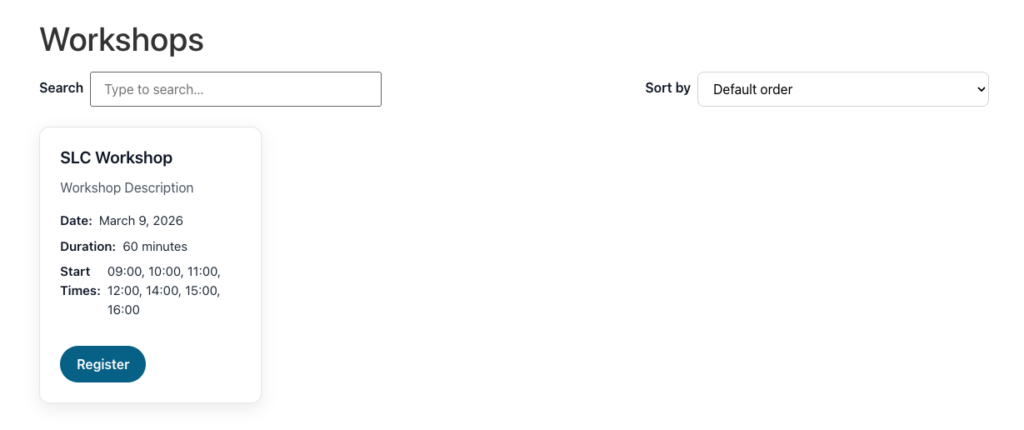
2. All available workshop time slots will be shown. Select your desired time and click “Register” to confirm your spot. Ensure that your desired time does not conflict with your competitive event.
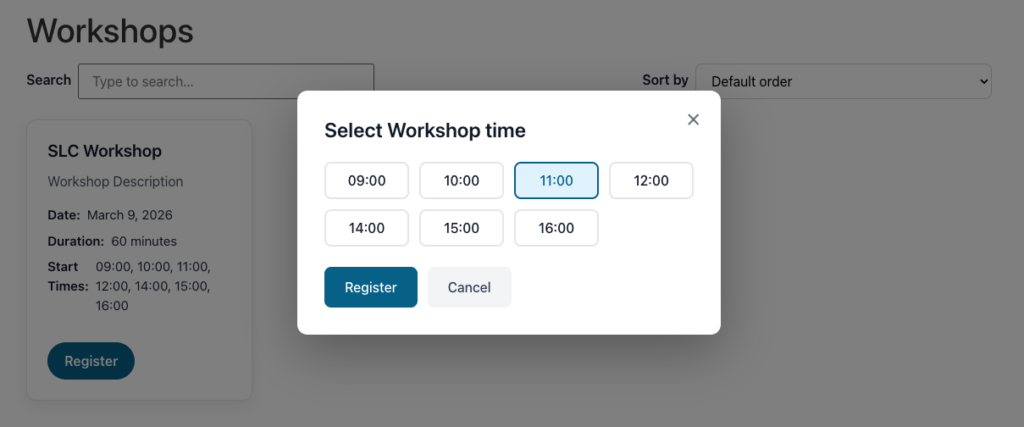
3. Upon successful registration, you will see a confirmation message and the workshop status will switch to Registered.
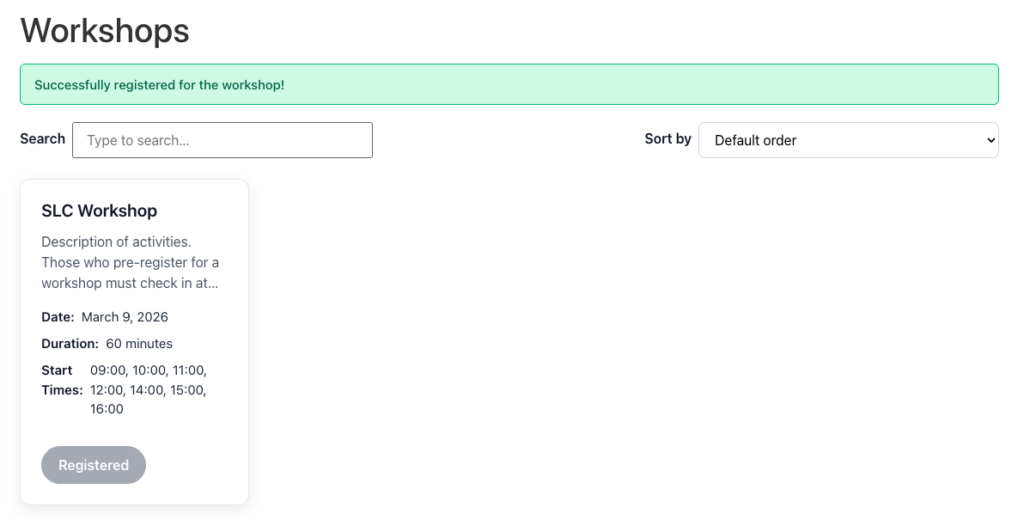
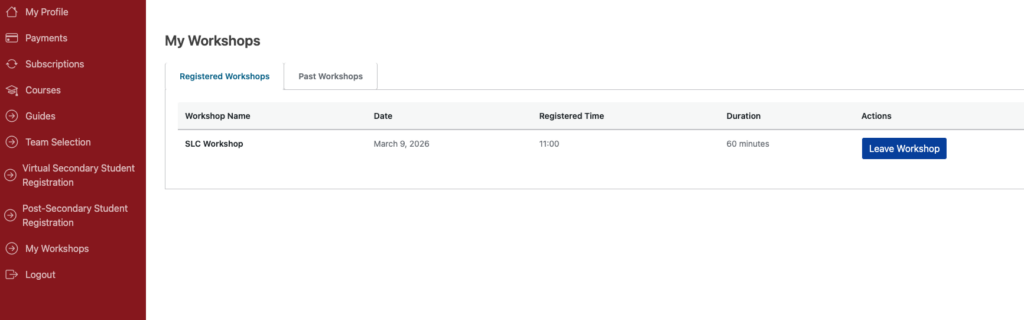
4. To view all your registered workshops or to leave a workshop, go to your profile and click “My Workshops” on the left bar.
March 9, 2026
Airway Management Basics
Time: 8:30AM-4:30PM
Room: 104B
Hosts: Anchal Badwal, Ayesha Hashmi
This workshop will introduce students to the life-saving fundamentals of airway management used in emergency and critical care. You’ll learn essential techniques for opening and clearing an airway, understand when each method is used, and explore how clinicians support breathing in urgent situations. You’ll also experience what it feels like to “bag” a patient using simulation equipment and observe a demonstration of endotracheal intubation.
AI in Healthcare: From Statistics to Machine Learning (and When to Use Each)
Time: 8:30AM-4:30PM
Room: 104D
Host: Mohsyn Malik
Artificial intelligence is changing how healthcare teams predict risk, plan treatments, and make decisions, especially in high-stakes areas like surgery. In this workshop, students will compare traditional statistical approaches with modern machine-learning tools, and learn why “more AI” isn’t always better. You’ll leave with a clearer picture of how healthcare researchers and clinicians decide between conventional statistics and machine learning, and what it actually takes to build AI that is useful, fair, and safe for patients.
Applied Research Skills
Time: 8:30AM-4:30PM
Room: 205D
Host: Susan Zhou
This workshop builds on the concepts introduced in our online seminar, giving students a deeper, hands-on look at how real research is designed and carried out. Students will explore different research methods and learn how various study types and tools are used to answer scientific questions. The session will then shift to an interactive activity where you’ll develop your own research question, outline a study, or practice skills such as finding papers and crafting effective cold emails to labs. This workshop is a practical introduction to the skills necessary to begin a journey in research.
Applying to an Undergraduate Health Science Program in Ontario
Time: 8:30AM-4:30PM
Room: 205C
Hosts: Arani Hiritharan, Tracy Xu, Rishi Patel, Sharon Zhang, Linda Duong
Are you interested in pursuing an undergraduate Health Science degree in Ontario? This workshop provides a clear overview of the application process for competitive Health Science programs across the province, including highly sought-after options such as McMaster and Queen’s Health Sciences. You will learn how programs assess applicants, what academic and extracurricular experiences strengthen an application, and how to effectively communicate your interests and personal insights through supplementary components. This workshop will also cover required high school courses, key application timelines, and common admission requirements.
Casting Bones - Masterclass: Fractures and Dislocations
Time: 8:30AM-4:30PM
Room: 206C/D
Hosts: Nima Nezhadi, Vanessa Wilson, Aazad Abbas, Robert Koucheki, Nick Yee, Athena Mancini
Are you interested in learning how to cast? Learn the basics of fractures, fracture patterns and how to cast during this workshop! This hands-on and interactive workshop will teach you all the basics, guided by experienced instructors! No prior experience needed– just bring your curiosity and creativity!
Essential Suturing Techniques
Time: 8:00AM-5:00PM
Room: 206E/F
Hosts: Audrey Jong, Sean Lifshits, Victoria Tran, Andrew Dam, Shakil Popatia
This hands-on workshop introduces students to the foundational skills of suturing used in emergency medicine, surgery, and clinical care. You’ll learn how to handle surgical instruments, place basic stitches, and practice proper techniques on simulated tissue. The workshop will also cover knot tying, wound edges, and when different suture types are used in practice. Join us to learn one of the most essential clinical skills in healthcare!
Ethics in Action: Decision-Making in Modern Medicine
Time: 1:00PM-5:00PM
Room: 201E
Hosts: Evangeline Tsagarakis, Raahill Hassan
This case-based workshop introduces students to the ethical challenges that shape real clinical decision-making. You’ll examine scenarios involving patient consent, confidentiality, resource allocation, and moral responsibility, exploring how healthcare professionals balance competing values in complex situations. Through guided discussion and small-group activities, students will analyze different perspectives, defend their reasoning, and see how ethics influences everyday practice in medicine and healthcare.
Forensic Files and Crime Scenes
Time: 8:30AM-4:30PM
Room: 203C
Hosts: Harmil Kalia, Amel Sassi
This workshop introduces students to the science behind real-world forensic investigations. You’ll explore how forensic scientists and medical examiners apply biology, chemistry, and anatomy to analyze evidence and uncover what happened at a crime scene. You’ll also learn core concepts such as interpreting physical clues, understanding injury patterns, and distinguishing different causes of death. Finally, through an interactive case study, you’ll work through a series of clues to piece together the events leading to a victim’s death. Participate in a dynamic, hands-on workshop at the intersection of science, medicine, and justice!
Foundations of Electrocardiography
Time: 8:00AM-5:00PM
Room: 104C
Hosts: Bonnie Liu, Larry Nguyen
This workshop will introduce students to how healthcare professionals use electrocardiograms (ECGs) to assess the heart’s electrical activity. You’ll learn the basics of cardiac conduction and identify key components of an ECG waveform. This workshop will also describe differences in the conduction and pumping of your heart, allowing you to diagnose key diseases and learn about management! With interactive visuals and hands-on labeling activities, you’re guaranteed to leave this workshop with a clear introduction to a diagnostic tool widely used in medicine, nursing, cardiology, paramedicine, and other healthcare careers.
Fundamentals of Genetic Analysis: DNA Extraction
Time: 8:00AM-5:00PM
Room: 202A
Hosts: Trisha Suraj, Hailey Stack, Anika Agashe
This hands-on workshop introduces students to the basics of genetic analysis through a classic DNA extraction experiment. Students will break down strawberries, isolate visible strands of DNA, and observe them under a microscope. This workshop also explores how these foundational techniques connect to modern applications such as genetic testing, sequencing, and CRISPR gene editing.
Health Equity: Understanding the Factors that Shape Well-Being
Time: 8:00AM-5:00PM
Room: 206B
Hosts: Pashtana Fakhrizada, Oyinda Obigbesan
This workshop explores how health is influenced by far more than physical symptoms. Students will learn how factors such as language, culture, race, income, education, and geographic location create barriers to care and contribute to unequal health outcomes. Through discussion and real-world examples, you’ll learn how clinicians and policymakers work to address these inequities. This workshop will end with a collaborative case study where students propose solutions to a health equity challenge, encouraging critical thinking and compassionate problem-solving. You’ll leave this workshop with a powerful introduction to the social dimensions of modern healthcare.
How to Manage Debt and Credit with CFEE
Time: 11:00AM-12:30PM
Room: 205B
Host: Canadian Foundation for Economic Education
Debt and credit can be powerful tools, but only if used properly. Join us to learn ways to manage general debt, including deciding when it’s worth taking the debt in the first place; how to effectively manage a credit card; and why your credit score is so important for your future. Use debt and credit the right way, with confidence.
The goal of “How to Manage Debt and Credit” is to help you understand and navigate the ever-expanding world of borrowing. You will learn how to manage general debt, and the difference between “good” debt and “bad” debt; how to use credit cards as a resource and a tool for your future; and what a credit score is, why it’s important, and strategies to improve a weak score or maintain a strong one. Debt and credit can be powerful tools, or dangerous opportunities. Take the time to learn how to use them correctly and you will thank yourself down the road.
How to Pay for School with CFEE
Time: 1:00PM-2:30PM
Room: 205B
Host: Canadian Foundation for Economic Education
A post-secondary education in Canada is a significant investment and can cost $10,000+ per year. Join us to learn some of the ways you can pay for your education, important details about taking on and repaying government student loans, and the impact of being a student on your credit score. You’re in post-secondary to plan for your future, start now by planning for post-secondary.
The goal of “How to Pay for School” is to help you prepare for your post-secondary education by thinking about how you plan to pay for it, and what the longer-term consequences of that payment approach may be. You will learn about some of the ways available to pay for your education, including scholarships and bursaries, loans, and government programs; some of the finer details of government student loans, related to both taking them on, and paying them back; and how being a student can affect your credit score, including ways to build your score as a student. Without a proper plan, the cost of a post-secondary education can feel like an insurmountable obstacle. Think ahead, so you can get ahead.
How to Read a Research Paper
Time: 8:00AM-5:00PM
Room: 206A
Hosts: Emma Pineau, Jashnoor Chhina
This workshop teaches students how to confidently navigate scientific papers and academic literature. Students will learn where to search for reliable publications, how to identify credible sources, and how to focus on the key sections of a paper. This workshop breaks down common terminology, reading strategies, and note-taking approaches to help students understand research more efficiently. You are certain to leave this workshop with a strong head start in reading, interpreting, and engaging with scientific literature.
Introduction to Anesthesia: Behind the Curtain
Time: 8:00AM-5:00PM
Room: 103A
Hosts: Dionne Hsu, Malcolm Serran
This immersive workshop gives you a behind-the-scenes look at the world of anesthesia and perioperative care. You will learn the basics of vital signs, common anesthetic plans, and how anesthesia teams prepare patients for surgery. This workshop also addresses anesthetic emergencies, decision-making under pressure, and core skills such as inserting IVs using simulation equipment. With guided demonstrations and interactive activities, you will gain a realistic understanding of the responsibilities of anesthesiologists and anesthesia assistants.
Introduction to Family Medicine
Time: 8:30AM-4:30PM
Room: 103B
Hosts: Anne Hu, Vince Wu
This workshop offers an inside look at one of the most fundamental fields in healthcare: family medicine. Students will explore the training pathway to become a family physician in Canada, from undergraduate studies to residency, and learn what skills and qualities the specialty values. Through real-world examples and discussion, we’ll highlight the day-to-day responsibilities of family doctors, including patient assessments, preventive care, chronic disease management, and community-based practice. If you’re interested in a broad, patient-centered medical career that blends long-term relationships, problem-solving, and continuous learning, this is the workshop for you!
Introductory Vital Signs Assessment
Time: 8:00AM-5:00PM
Room: 205A
Hosts: Jaswanth Gorla, Fatima Bah
This workshop demonstrates how healthcare professionals measure and interpret the core vital signs that reflect a patient’s health status. Students will learn proper techniques for assessing pulse, respiration rate, and blood pressure through hands-on demonstrations and guided practice. Using mock patient scenarios, students will apply these skills to recognize normal and abnormal findings and understand how vital signs inform clinical decision-making. This is a great foundational introduction to skills relevant to nursing, medicine, or emergency care.
Living a Financially Healthy Life with CFEE
Time: 9:00AM-10:30AM
Room: 205B
Host: Canadian Foundation for Economic Education
Finances are an unavoidable and important part of life. Join us to examine the foundational skills of budgeting, goal setting, saving, and effective spending. With these concepts under your belt, you’ll be ready for the next stages of your financial journey.
The goal of “Living a Financially Healthy Life” is to help you develop a healthy attitude towards money. Coming out of this workshop you will be able to make more informed decisions about purchases, be able to create a budget that includes savings and can help reduce your financial stress and know how to apply the magic of compound interest to increase your savings. You will learn how to take control of your money by setting goals and creating a budget that emphasizes paying yourself first; how to recognize the difference between a need and a want; and why it’s important to make savings an integral part of your life, not an afterthought.
Ophthalmology 101
Time: 8:00AM-5:00PM
Room: 203A
Hosts: Lauren Calicchia, Phoebe Ji
This hands-on workshop introduces students to core clinical skills used in eye examinations. You’ll have the opportunity to perform visual acuity tests, colour vision testing, and visual field assessments to understand how different techniques help evaluate different aspects of sight. Students will also learn how to use a penlight to assess pupil size, reactivity, and neurological function. Through guided practice and interactive demonstrations, this workshop provides a practical, engaging introduction to the fundamentals of ophthalmology and the critical role eye exams play in diagnosing medical and neurological conditions.
Preparing for the Future of Work and Your Career with CFEE
Time: 3:00PM-4:30PM
Room: 205B
Host: Canadian Foundation for Economic Education
The world is changing. Join us to examine these changes, how they’re affecting workplaces, and some of the skills you can work on to stay in high demand. Don’t just embrace the future, help make it.
The goal of “Preparing for the Future of Work and Your Career” is to give you a better understanding of the transformation that is occurring in the workplace due to the fourth industrial revolution, and the skills you will need to succeed in your career. Times and workplaces are changing, an inevitability that was accelerated by the COVID-19 pandemic. You will learn how to look for the impact of these changes in your chosen field and anticipate what the future holds for the industry; how workplace and employee dynamics are being redesigned; and ways to highlight and improve the skills that will keep you in demand for years to come. The future is now. The future is you.
Stop the Bleed!
Time: 8:30AM-4:30PM
Room: 202C
Hosts: Emily D’Agostini, Mariane Ratsimor
This fast-paced, hands-on workshop teaches students the essential skills used to control life-threatening bleeding in emergency situations. You’ll get to practice applying direct pressure, packing wounds, tying tourniquets, and creating slings or wraps. Students will learn how quick, effective action can stabilize a patient before advanced care arrives. This workshop is a practical and engaging introduction to the fundamentals of trauma response and first aid.
Sunshine Therapy Dogs
Time: 9:00AM-10:15AM; 11:00AM-12:15PM
Room: 104A
Did you know that interacting with therapy animals is scientifically proven to reduce stress, anxiety, and blood pressure in people of all ages? Come meet some of our friendly, local Sunshine Therapy Dogs and their volunteer handlers to enjoy some quiet decompression time and experience first-hand the healing power of animal-assisted therapies. Learn more about our charity’s services and available support options at: www.sunshinetherapydogs.ca.
DOES NOT COUNT TOWARDS HPWP
March 10, 2026
AI in Healthcare: From Statistics to Machine Learning (and When to Use Each)
Time: 8:00AM-5:00PM
Room: 206B
Host: Mohsyn Malik
Artificial intelligence is changing how healthcare teams predict risk, plan treatments, and make decisions, especially in high-stakes areas like surgery. In this workshop, students will compare traditional statistical approaches with modern machine-learning tools, and learn why “more AI” isn’t always better. You’ll leave with a clearer picture of how healthcare researchers and clinicians decide between conventional statistics and machine learning, and what it actually takes to build AI that is useful, fair, and safe for patients.
Casting Bones - Masterclass: Fractures and Dislocations
Time: 8:30AM-4:30PM
Room: 206C/D
Hosts: Nima Nezhadi, Vanessa Wilson, Aazad Abbas, Robert Koucheki, Nick Yee, Athena Mancini
Are you interested in learning how to cast? Learn the basics of fractures, fracture patterns and how to cast during this workshop! This hands-on and interactive workshop will teach you all the basics, guided by experienced instructors! No prior experience needed– just bring your curiosity and creativity!
Emergency Response Basics
Time: 12:30PM-4:30PM
Room: 103B
Hosts: Fatima Bah, Emily D’Agostini
This hands-on workshop teaches you what to do in the crucial first minutes of a medical emergency. Students will practice CPR, learn how to safely use an automated external defibrillator, and review the key steps in assessing and responding to common urgent situations. Through guided practice with simulation equipment, you will build confidence and understanding in how early intervention saves lives. This workshop is practical and empowering, whether you’re interested in pursuing a healthcare career or simply looking to gain essential skills for everyday life.
Essential Suturing Techniques
Time: 8:00AM-5:00PM
Room: 206E/F
Hosts: Audrey Jong, Sean Lifshits, Yu Chen Qian, Andrew Dam, Shakil Popatia
This hands-on workshop introduces students to the foundational skills of suturing used in emergency medicine, surgery, and clinical care. You’ll learn how to handle surgical instruments, place basic stitches, and practice proper techniques on simulated tissue. The workshop will also cover knot tying, wound edges, and when different suture types are used in practice. Join us to learn one of the most essential clinical skills in healthcare!
Explore the Canadian Research Landscape: PhD Student Seminar Talks - Medical Biophysics
Time: 12:00PM-1:00PM
Room: 106
Host: Shreya Kanade
These seminar talks will introduce you to the world of academic research in Canada through engaging talks led by current PhD students across varying disciplines. Each speaker will begin with an accessible overview of their field, before sharing insights into their current research projects. Following each talk, students will have 10-15 minutes to ask each speaker general questions. Each speaker will then transition to the Graduate Student Mixer, where HOSA Canada students can connect 1:1 with current PhD researchers, ask individual questions, and learn more about pathways into research and graduate studies.
DOES NOT COUNT TOWARDS HPWP
Explore the Canadian Research Landscape: PhD Student Seminar Talks - Computational Biology
Time: 9:00AM-10:00AM
Room: 106
Host: Alexander Turco
These seminar talks will introduce you to the world of academic research in Canada through engaging talks led by current PhD students across varying disciplines. Each speaker will begin with an accessible overview of their field, before sharing insights into their current research projects. Following each talk, students will have 10-15 minutes to ask each speaker general questions. Each speaker will then transition to the Graduate Student Mixer, where HOSA Canada students can connect 1:1 with current PhD researchers, ask individual questions, and learn more about pathways into research and graduate studies.
DOES NOT COUNT TOWARDS HPWP
Explore the Canadian Research Landscape: PhD Student Seminar Talks - Kinesiology
Time: 10:30AM-11:30AM
Room: 106
Host: Thomas Leaf
These seminar talks will introduce you to the world of academic research in Canada through engaging talks led by current PhD students across varying disciplines. Each speaker will begin with an accessible overview of their field, before sharing insights into their current research projects. Following each talk, students will have 10-15 minutes to ask each speaker general questions. Each speaker will then transition to the Graduate Student Mixer, where HOSA Canada students can connect 1:1 with current PhD researchers, ask individual questions, and learn more about pathways into research and graduate studies.
DOES NOT COUNT TOWARDS HPWP
Explore the Canadian Research Landscape: PhD Student Seminar Talks - Immunology
Time: 1:30PM-2:30PM
Room: 106
Host: Alara Tuncer
These seminar talks will introduce you to the world of academic research in Canada through engaging talks led by current PhD students across varying disciplines. Each speaker will begin with an accessible overview of their field, before sharing insights into their current research projects. Following each talk, students will have 10-15 minutes to ask each speaker general questions. Each speaker will then transition to the Graduate Student Mixer, where HOSA Canada students can connect 1:1 with current PhD researchers, ask individual questions, and learn more about pathways into research and graduate studies.
DOES NOT COUNT TOWARDS HPWP
Explore the Canadian Research Landscape: PhD Student Seminar Talks - Pharmaceutical Sciences
Time: 3:00PM-4:00PM
Room: 106
Host: Ariel Corsano
These seminar talks will introduce you to the world of academic research in Canada through engaging talks led by current PhD students across varying disciplines. Each speaker will begin with an accessible overview of their field, before sharing insights into their current research projects. Following each talk, students will have 10-15 minutes to ask each speaker general questions. Each speaker will then transition to the Graduate Student Mixer, where HOSA Canada students can connect 1:1 with current PhD researchers, ask individual questions, and learn more about pathways into research and graduate studies.
DOES NOT COUNT TOWARDS HPWP
Future Health Opportunities Expo
Time: 9:00AM-5:00PM
Room: 105
Explore pathways into health sciences through a booth-based expo featuring universities, summer programs, research training opportunities, scholarships, mentorship initiatives, and other career-building experiences. This walk-in session is designed for students who want practical next steps: learn about eligibility, application timelines, costs (including paid and funded options), and what makes a strong candidate!
Stop by booths such as:
- Summer research and enrichment programs
- National opportunities and paid education pathways
- Scholarships, mentorship, and leadership programs
- Training and education providers
Come anytime during the session, ask questions 1:1, collect resources, and leave with a clear plan for what opportunities to pursue next.
A complete list of vendors will be announced in the upcoming weeks.
Genetic Counseling 101: Solving Family Health Mysteries
Time: 1:30PM-4:30PM
Room: 104D
Host: Stephanie Chuang
Discover how genetic counselors use family histories, patterns of inheritance, and genetic testing to uncover the causes of disease! You will get the chance to work through real-world style cases, map pedigrees, and practice explaining results in clear, supportive language. This is a great workshop for students interested in a career that offers a mix of science, problem-solving, and compassionate communication skills!
Graduate Student Mixer
Time: 10:00AM-5:00PM
Room: 107
Connect 1:1 with graduate students and early-career researchers from a range of health- and science-related disciplines. This drop-in mixer is designed for curious conversations: ask questions about programs and admissions, research life, choosing a field, funding, and career pathways inside and outside academia.
Graduate students will be available at themed tables, including:
- Quantitative & Computational Health Sciences
- Human Performance, Sport & Rehabilitation Sciences
- Cancer, Genetics & Molecular Medicine
- Immunity, Inflammation & Stress Biology
- Therapeutics, Diagnostics & Biotechnology
Whether you’re exploring career options or already have a direction in mind, come prepared with questions and leave with practical insights, new connections, and a clearer sense of what graduate study can look like. Walk in anytime during the session; short chats are encouraged so more students can participate!
History Taking: Internal Medicine Fundamentals
Time: 8:00AM-5:00PM
Room: 203C
Hosts: Shilpa Balaji, Vince Wu
This workshop introduces students to one of the most essential skills in healthcare: taking a clear, structured medical history. Through a hypothetical internal-medicine scenario, students will practice asking focused questions about symptoms, medical conditions, medications, lifestyle factors, and red flags. You will learn how clinicians use patient histories to narrow down possible diagnoses, guide investigations, and build rapport. This workshop emphasizes active listening, clarity, and clinical reasoning, which are all core skills for anyone interested in healthcare careers.
How to Get Research Experience in High School or Early Undergrad
Time: 8:00AM-5:00PM
Room: 205A
Hosts: Lauren Calicchia, Arani Hiritharan
Want to know practical strategies for breaking into research early? Learn to identify labs accepting students, craft effective cold emails, and understand what professors look for in new trainees. This workshop will cover how to build small independent projects, showcase relevant skills, and navigate opportunities in university, hospital, and community research settings. With tips drawn from current researchers, students will leave with a clear roadmap for getting started in scientific inquiry long before upper-year courses begin.
How to Manage Debt and Credit with CFEE
Time: 11:00AM-12:30PM
Room: 205B
Host: Canadian Foundation for Economic Education
Debt and credit can be powerful tools, but only if used properly. Join us to learn ways to manage general debt, including deciding when it’s worth taking the debt in the first place; how to effectively manage a credit card; and why your credit score is so important for your future. Use debt and credit the right way, with confidence.
The goal of “How to Manage Debt and Credit” is to help you understand and navigate the ever-expanding world of borrowing. You will learn how to manage general debt, and the difference between “good” debt and “bad” debt; how to use credit cards as a resource and a tool for your future; and what a credit score is, why it’s important, and strategies to improve a weak score or maintain a strong one. Debt and credit can be powerful tools, or dangerous opportunities. Take the time to learn how to use them correctly and you will thank yourself down the road.
How to Pay for School with CFEE
Time: 1:00PM-2:30PM
Room: 205B
Host: Canadian Foundation for Economic Education
A post-secondary education in Canada is a significant investment and can cost $10,000+ per year. Join us to learn some of the ways you can pay for your education, important details about taking on and repaying government student loans, and the impact of being a student on your credit score. You’re in post-secondary to plan for your future, start now by planning for post-secondary.
The goal of “How to Pay for School” is to help you prepare for your post-secondary education by thinking about how you plan to pay for it, and what the longer-term consequences of that payment approach may be. You will learn about some of the ways available to pay for your education, including scholarships and bursaries, loans, and government programs; some of the finer details of government student loans, related to both taking them on, and paying them back; and how being a student can affect your credit score, including ways to build your score as a student. Without a proper plan, the cost of a post-secondary education can feel like an insurmountable obstacle. Think ahead, so you can get ahead.
How to Read a Research Paper
Time: 8:00AM-5:00PM
Room: 206A
Hosts: Emma Pineau, Jashnoor Chhina
This workshop teaches students how to confidently navigate scientific papers and academic literature. Students will learn where to search for reliable publications, how to identify credible sources, and how to focus on the key sections of a paper. This workshop breaks down common terminology, reading strategies, and note-taking approaches to help students understand research more efficiently. You are certain to leave this workshop with a strong head start in reading, interpreting, and engaging with scientific literature.
Living a Financially Healthy Life with CFEE
Time: 9:00AM-10:30AM
Room: 205B
Host: Canadian Foundation for Economic Education
Finances are an unavoidable and important part of life. Join us to examine the foundational skills of budgeting, goal setting, saving, and effective spending. With these concepts under your belt, you’ll be ready for the next stages of your financial journey.
The goal of “Living a Financially Healthy Life” is to help you develop a healthy attitude towards money. Coming out of this workshop you will be able to make more informed decisions about purchases, be able to create a budget that includes savings and can help reduce your financial stress and know how to apply the magic of compound interest to increase your savings. You will learn how to take control of your money by setting goals and creating a budget that emphasizes paying yourself first; how to recognize the difference between a need and a want; and why it’s important to make savings an integral part of your life, not an afterthought.
Point-of-care ultrasound (POCUS): A Window into the Body's Mysteries
Time: 8:00AM-5:00PM
Room: 202B
Hosts: Evangeline Tsagarakis, Rahil Prajapati
This practical, interactive workshop introduces students to how portable ultrasound is used in emergency and bedside medicine. You’ll observe real-time scans and learn how clinicians use POCUS to visualize internal structures quickly and identify simple pathologies. Using real ultrasound equipment, students will explore how this powerful, non-invasive tool guides rapid decision-making and enhances patient care.
Preparing for the Future of Work and Your Career with CFEE
Time: 3:00PM-4:30PM
Room: 205B
Host: Canadian Foundation for Economic Education
The world is changing. Join us to examine these changes, how they’re affecting workplaces, and some of the skills you can work on to stay in high demand. Don’t just embrace the future, help make it.
The goal of “Preparing for the Future of Work and Your Career” is to give you a better understanding of the transformation that is occurring in the workplace due to the fourth industrial revolution, and the skills you will need to succeed in your career. Times and workplaces are changing, an inevitability that was accelerated by the COVID-19 pandemic. You will learn how to look for the impact of these changes in your chosen field and anticipate what the future holds for the industry; how workplace and employee dynamics are being redesigned; and ways to highlight and improve the skills that will keep you in demand for years to come. The future is now. The future is you.
Public Health Case Study
Time: 1:30PM-4:30PM
Room: 104C
Hosts: Pashtana Fakhrizada, Tracy Xu
This workshop will introduce students to the core principles of public health and how communities address widespread health challenges. After a brief overview of key strategies, such as prevention, surveillance, and policy, you’ll have the chance to examine a real-world style case and apply what you’ve learned and propose practical solutions. This workshop will highlight how public health decisions are made and how multiple voices shape population-level health outcomes.
Race to the OR: Scrub-In Competition
Time: 8:30AM-4:30PM
Room: 205D
Hosts: Nicole Chu, Layya Al Malouf, Sabrina Saladeen
This interactive competition teaches students the importance of proper surgical handwashing and contamination control. Students will apply glow germ powder to simulate bacteria, complete a short task to “spread” contamination, then wash their hands as they normally would. After a brief lesson on the WHO six-step technique, students will then retry their handwashing technique and compare results. Join for a fun and eye-opening workshop that highlights how crucial hand hygiene is in surgical and emergency settings.
Sensing the World: How We Hear, Balance, and Stay Oriented
Time: 8:30AM-4:30PM
Room: 202D
Hosts: Mariane Ratsimor, Sharon Zhang
This workshop explores how the inner ear and cerebellum work together to maintain balance, coordination, and stable vision. Through simple head-turn and focus tests, students will see how clinicians assess dizziness, vestibular disorders, and cerebellar dysfunction. You’ll learn how disruptions in these systems affect hearing, orientation, and movement, and observe key signs used in diagnosis. This workshop also highlights related career paths, including audiology, neurology, neuro-ophthalmology, and rehabilitation medicine.
Speaking with Impact: Public Communication in Healthcare
Time: 12:00PM-5:00PM
Room: 103A
Hosts: Kristen Kyone, Ava Kavianpour
This interactive workshop will aid you in building confidence, clarity, and presence when communicating in healthcare settings. Through hands-on activities and guided practice, you will learn strategies for speaking effectively with patients, peers, and professional audiences. This workshop focuses on organizing ideas, reducing filler language, projecting confidence, and adapting communication styles to different situations. Whether leading a discussion or navigating challenging conversations, you are certain to gain practical tools to help you speak with impact and professionalism!
Stroke 360°: Spot, Stop, Save
Time: 8:30AM-4:30PM
Room: 205C
Host: Suzanne Li, Ayush Patel
Every second counts when it comes to a stroke. In this interactive workshop, you will learn how to recognize the warning signs, understand what happens in the brain during a stroke, and explore the life-saving treatments used to stop its effects. Through real-world scenarios and hands-on activities, you’ll leave this workshop with greater insight into how healthcare professionals act fast to prevent long-term damage and save lives.
Sunshine Therapy Dogs
Time: 1:30PM-2:45PM; 3:30PM-4:45PM
Room: 104A
Did you know that interacting with therapy animals is scientifically proven to reduce stress, anxiety, and blood pressure in people of all ages? Come meet some of our friendly, local Sunshine Therapy Dogs and their volunteer handlers to enjoy some quiet decompression time and experience first-hand the healing power of animal-assisted therapies. Learn more about our charity’s services and available support options at: www.sunshinetherapydogs.ca.
DOES NOT COUNT TOWARDS HPWP
March 11, 2026
All About Sickkids Kids Science Program
Time: 1:30PM-3:30PM
Room: 205A
Hosts: David Manly
Located at The Hospital for Sick Children (SickKids), the Kids Science program was created in 2006 to educate and inspire youth with interactive, hands-on science experiences – including internships, mentorship programs, on-site lab visits, school visits, and demonstrations both in the hospital and across Toronto and the GTA. This session will highlight SickKids, its research, the various programs that Kids Science runs, as well as opportunities (both paid and unpaid) for high school and undergraduate students.
Beyond Medicine: Exploring Non-Traditional Health Careers
Time: 8:00AM-3:00PM
Room: 104C
Hosts: Saakshi Khosla, Aashka Patel, Eesha Nasir Chaudhry, Anchal Badwal, Ayesha Hashmi
This workshop will introduce students to the wide range of career options available to health science graduates beyond traditional clinical medicine. You’ll hear firsthand from those working as chiropractors, physician assistants, respiratory therapists, pharmacists, and in public policy development. This is a great workshop for anyone curious about the many career paths within healthcare and health systems beyond becoming a physician.
Building your Resume
Time: 8:00AM-3:00PM
Room: 203A
Hosts: Rishi Patel
Not sure how to turn your school, volunteer, and leadership experiences into a resume that truly stands out? In this workshop, learn how to build a clear, professional resume, whether you’re applying for a competition, summer program, scholarship, research position, or part-time job. We’ll break down the essential sections, strong bullet-point writing, and how to highlight impact. You’ll also learn common formatting mistakes to avoid, tailoring tips, and how to describe experiences with confidence and credibility. Leave with a resume structure you can reuse and improve as you gain experience!
DNA Tracks: Electrophoresis Case Investigation
Time: 8:30AM-3:30PM
Room: 202D
Hosts: Maria Alex, Aspen Tang
This hands-on workshop introduces students to gel electrophoresis through a fun, crime-scene investigation challenge. Using pipettes or syringes and jello-based gels, you will learn how DNA fragments are separated and visualized in the lab. After reviewing pre-made electrophoresis results, students will analyze the band patterns to identify suspects and piece together a mock forensic case. Join to explore the techniques behind DNA profiling and real-world forensic science!
CASPer Strategy & Skills with AcceptedTogether
Time: 8:00AM-3:00PM
Room: 206B
Host: AcceptedTogether
This workshop will outline the fundamentals skills you need to know to succeed on the CASPer examination. We’ll break down how the CASPer exam is designed, what it’s evaluating, and important tips on clearly articulating responses to different scenarios that will show up on the exam. We’ll also address practical approaches to quickly analyze prompts, managing time under pressure, and common pitfalls that weaken otherwise strong answers. You’ll leave with clear strategies for tackling any question scenarios, more confidence in your responses, and a solid foundation to continue refining your situational judgement skills.
Emergency Department Simulation
Time: 8:30AM-3:30PM
Room: 202C
Hosts: Natasha Verhoeff, Fatima Bah
This immersive workshop gives students a realistic look into how an emergency department functions under pressure. You will learn the basics of ER workflow, and rotate through interactive stations to assess patients, interpret symptoms, and make rapid treatment decisions. Students will learn how triage works and how providers prioritize care based on urgency and available resources. This is an invaluable hands-on introduction to the fast-paced decision-making that defines emergency medicine.
Essential Suturing Techniques
Time: 8:00AM-3:00PM
Room: 206E/F
Hosts: Audrey Jong, Sean Lifshits, Yu Chen Qian, Andrew Dam, Shakil Popatia
This hands-on workshop introduces students to the foundational skills of suturing used in emergency medicine, surgery, and clinical care. You’ll learn how to handle surgical instruments, place basic stitches, and practice proper techniques on simulated tissue. The workshop will also cover knot tying, wound edges, and when different suture types are used in practice. Join us to learn one of the most essential clinical skills in healthcare!
Fundamentals of Genetic Analysis: DNA Extraction
Time: 8:00AM-3:30PM
Room: 201F
Hosts: Trisha Suraj, Hailey Stack, Anika Agashe
This hands-on workshop introduces students to the basics of genetic analysis through a classic DNA extraction experiment. Students will break down strawberries, isolate visible strands of DNA, and observe them under a microscope. This workshop also explores how these foundational techniques connect to modern applications such as genetic testing, sequencing, and CRISPR gene editing.
Getting Nervous? History & Physical Exam of the Nervous System
Time: 8:30AM-3:30PM
Room: 203C
Hosts: Manpreet Kaur Jagdev, Sarah Curtay
This workshop introduces students to how clinicians examine the nervous system through both history-taking and physical tests. You’ll try hands-on activities, including reflex testing, reaction-time challenges, simple circuits, and sensory checks like the toothpick test, to learn how the sensory and motor pathways work. This workshop also explains the core elements of a real neurological exam and how these findings help diagnose disorders. Students will also learn about the training pathways and day-to-day work in neurology, neurosurgery, neuro-ophthalmology, and related fields.
How to Manage Debt and Credit with CFEE
Time: 10:00AM-11:30AM
Room: 205B
Host: Canadian Foundation for Economic Education
Debt and credit can be powerful tools, but only if used properly. Join us to learn ways to manage general debt, including deciding when it’s worth taking the debt in the first place; how to effectively manage a credit card; and why your credit score is so important for your future. Use debt and credit the right way, with confidence.
The goal of “How to Manage Debt and Credit” is to help you understand and navigate the ever-expanding world of borrowing. You will learn how to manage general debt, and the difference between “good” debt and “bad” debt; how to use credit cards as a resource and a tool for your future; and what a credit score is, why it’s important, and strategies to improve a weak score or maintain a strong one. Debt and credit can be powerful tools, or dangerous opportunities. Take the time to learn how to use them correctly and you will thank yourself down the road.
How to Pay for School with CFEE
Time: 12:00PM-1:30PM
Room: 205B
Host: Canadian Foundation for Economic Education
A post-secondary education in Canada is a significant investment and can cost $10,000+ per year. Join us to learn some of the ways you can pay for your education, important details about taking on and repaying government student loans, and the impact of being a student on your credit score. You’re in post-secondary to plan for your future, start now by planning for post-secondary.
The goal of “How to Pay for School” is to help you prepare for your post-secondary education by thinking about how you plan to pay for it, and what the longer-term consequences of that payment approach may be. You will learn about some of the ways available to pay for your education, including scholarships and bursaries, loans, and government programs; some of the finer details of government student loans, related to both taking them on, and paying them back; and how being a student can affect your credit score, including ways to build your score as a student. Without a proper plan, the cost of a post-secondary education can feel like an insurmountable obstacle. Think ahead, so you can get ahead.
How to Read a Research Paper
Time: 8:00AM-3:00PM
Room: 206A
Host: Emma Pineau, Jashnoor Chhina
This workshop teaches students how to confidently navigate scientific papers and academic literature. Students will learn where to search for reliable publications, how to identify credible sources, and how to focus on the key sections of a paper. This workshop breaks down common terminology, reading strategies, and note-taking approaches to help students understand research more efficiently. You are certain to leave this workshop with a strong head start in reading, interpreting, and engaging with scientific literature.
Living a Financially Healthy Life with CFEE
Time: 8:00AM-9:30AM
Room: 205B
Host: Canadian Foundation for Economic Education
Finances are an unavoidable and important part of life. Join us to examine the foundational skills of budgeting, goal setting, saving, and effective spending. With these concepts under your belt, you’ll be ready for the next stages of your financial journey.
The goal of “Living a Financially Healthy Life” is to help you develop a healthy attitude towards money. Coming out of this workshop you will be able to make more informed decisions about purchases, be able to create a budget that includes savings and can help reduce your financial stress and know how to apply the magic of compound interest to increase your savings. You will learn how to take control of your money by setting goals and creating a budget that emphasizes paying yourself first; how to recognize the difference between a need and a want; and why it’s important to make savings an integral part of your life, not an afterthought.
Medical Innovation 101: How Non-Physicians are Shaping Healthcare
Time: 8:00AM-3:00PM
Room: 104A
Hosts: Hamza Fakhrizada, Mazen Moustafa
This workshop explores how engineers, designers, and entrepreneurs drive innovation in modern healthcare. Students will learn how medical technologies, such as diagnostic devices, wearables, and digital health tools, are developed through collaboration between technical and clinical teams. This is a great workshop for students interested in the intersection of health, technology, and creative innovation.
Medical Radiation Technology: Imaging Interpretation 101
Time: 8:00AM-3:00PM
Room: 202B
Host: Malcolm Serran, Anita Singh
This interactive workshop introduces students to the fundamentals of interpreting medical images used across healthcare. You’ll learn how to look at common scans and identify basic findings like fractures, infections, and organ abnormalities. Instead of a traditional lecture, students will work hands-on with sample images, practicing how technologists and clinicians approach real diagnostic cases. This is a great workshop for anyone interested in medical imaging, radiology, or the technology behind modern diagnostic care.
Medical School Journey: Live Q&A
Time: 8:30AM-10:00AM; 10:30AM-12:00PM; 12:30PM-2:00PM
Room: 206C/D
Hosts: Shilpa Balaji, Kristen Kyone, Ava Kavianpour, Juliana Podobnik
Join this interactive Q&A to hear directly from medical students about the path to medical school. Topics include but are not limited to academic preparation, extracurricular involvement, research experiences, applications, interviews, and maintaining balance and wellness throughout the process. All participating students are encouraged to ask questions and engage in an open discussion about challenges, decision-making, and lessons learned along the journey to medical school.
Microbiology Culture & Analysis Lab
Time: 8:30AM-3:30PM
Room: 104B
Hosts: Stephanie Chuang, Janice Tai, Mariane Ratsimor
This interactive workshop gives students a hands-on introduction to common lab techniques in microbiology. You’ll swab common surfaces, analyze the collected bacteria on growth media, and compare how different environments influence microbial growth. Along the way, you will also learn safe handling practices and how microbiologists interpret colony patterns. This workshop offers a simple, yet eye-opening, experiment that reveals the unseen microbial world and shows what working in a research or clinical lab is really like.
Mind Over Medicine: Managing Stress in Healthcare Training
Time: 8:30AM-3:30PM
Room: 205C
Host: Meghan Secord, Arooba Mansoor
This workshop equips students with practical tools to manage stress and maintain well-being in fast-paced academic and clinical environments. You’ll learn evidence-based strategies such as mindfulness techniques, grounding exercises, cognitive reframing, and healthy study habits used by healthcare trainees. Through guided activities and short reflections, students will explore how to build resilience, prevent burnout, and stay balanced during demanding programs. A supportive, skill-building workshop for anyone preparing for a future in healthcare.
Preparing for the Future of Work and Your Career with CFEE
Time: 2:00PM-3:30PM
Room: 205B
Host: Canadian Foundation for Economic Education
The world is changing. Join us to examine these changes, how they’re affecting workplaces, and some of the skills you can work on to stay in high demand. Don’t just embrace the future, help make it.
The goal of “Preparing for the Future of Work and Your Career” is to give you a better understanding of the transformation that is occurring in the workplace due to the fourth industrial revolution, and the skills you will need to succeed in your career. Times and workplaces are changing, an inevitability that was accelerated by the COVID-19 pandemic. You will learn how to look for the impact of these changes in your chosen field and anticipate what the future holds for the industry; how workplace and employee dynamics are being redesigned; and ways to highlight and improve the skills that will keep you in demand for years to come. The future is now. The future is you.
Public Health Outbreak: Identify the Source!
Time: 8:00AM-3:00PM
Room: 103A
Hosts: Amel Sassi, Kayla McCalla
In this hands-on workshop, you will take on the role of a public health investigator responding to a mysterious disease outbreak. Analyzing clues, mock data, and case reports will allow you to trace the source of the infection and determine how it spread. Through collaborative problem-solving, students will learn how epidemiologists identify patterns, generate hypotheses, and implement control measures to stop an outbreak.
Race to the OR: Scrub-In Competition
Time: 8:30AM-3:30PM
Room: 104D
Hosts: Nima Nezhadi, Layya Al Malouf, Sabrina Saladeen
This interactive competition teaches students the importance of proper surgical handwashing and contamination control. Students will apply glow germ powder to simulate bacteria, complete a short task to “spread” contamination, then wash their hands as they normally would. After a brief lesson on the WHO six-step technique, students will then retry their handwashing technique and compare results. Join for a fun and eye-opening workshop that highlights how crucial hand hygiene is in surgical and emergency settings.
The Future of Gene Editing
Time: 8:30AM-3:30PM
Room: 103B
Host: Rui (Raina) Wen
This workshop explores how emerging gene-editing technologies are transforming the future of medicine. You will analyze case studies involving genetic diseases to understand why and how specific genes might be targeted. Through simplified simulations, you will learn how tools like CRISPR can modify DNA and potentially cure inherited conditions. This workshop also includes a thoughtful discussion of the ethical dilemmas surrounding gene editing, including safety, equity, and the limits of human intervention.
Your Path to Dental School with Wizeprep
Time: 9:30AM-3:30PM
Room: 205D
Host: WizePrep
Your Path to Dental School is a must-attend event for students who are considering a future in dentistry. Whether you’re just beginning your pre-dental journey or getting ready to apply, this event is designed to give you clarity, confidence, and a clear roadmap forward.
You’ll learn what it really takes to become a competitive dental school applicant, including course planning, extracurriculars, DAT preparation, and application strategy. Led by Dr. Jessica Adams, this event offers honest insights, practical advice, and proven strategies you won’t find in textbooks.
By the end of the event, you’ll have a stronger understanding of the dental school pathway, the tools to make smarter decisions early, and the confidence to take your next steps toward a career in dentistry.
Your Path to Medical School with Wizeprep
Time: 8:30AM-2:30PM
Room: 205D
Host: WizePrep
Your Path to Medical School is a must-attend event for students who are considering a future in medicine. Whether you’re just beginning your pre-med journey or getting ready to apply, this event is designed to give you clarity, confidence, and a clear roadmap forward.
You’ll learn what it really takes to become a competitive medical school applicant, including course planning, extracurriculars, MCAT preparation, and application strategy. Led by Dr. Jessica Adams, this event offers honest insights, practical advice, and proven strategies you won’t find in textbooks.
By the end of the event, you’ll have a stronger understanding of the medical school pathway, the tools to make smarter decisions early, and the confidence to take your next steps toward a career in medicine.